
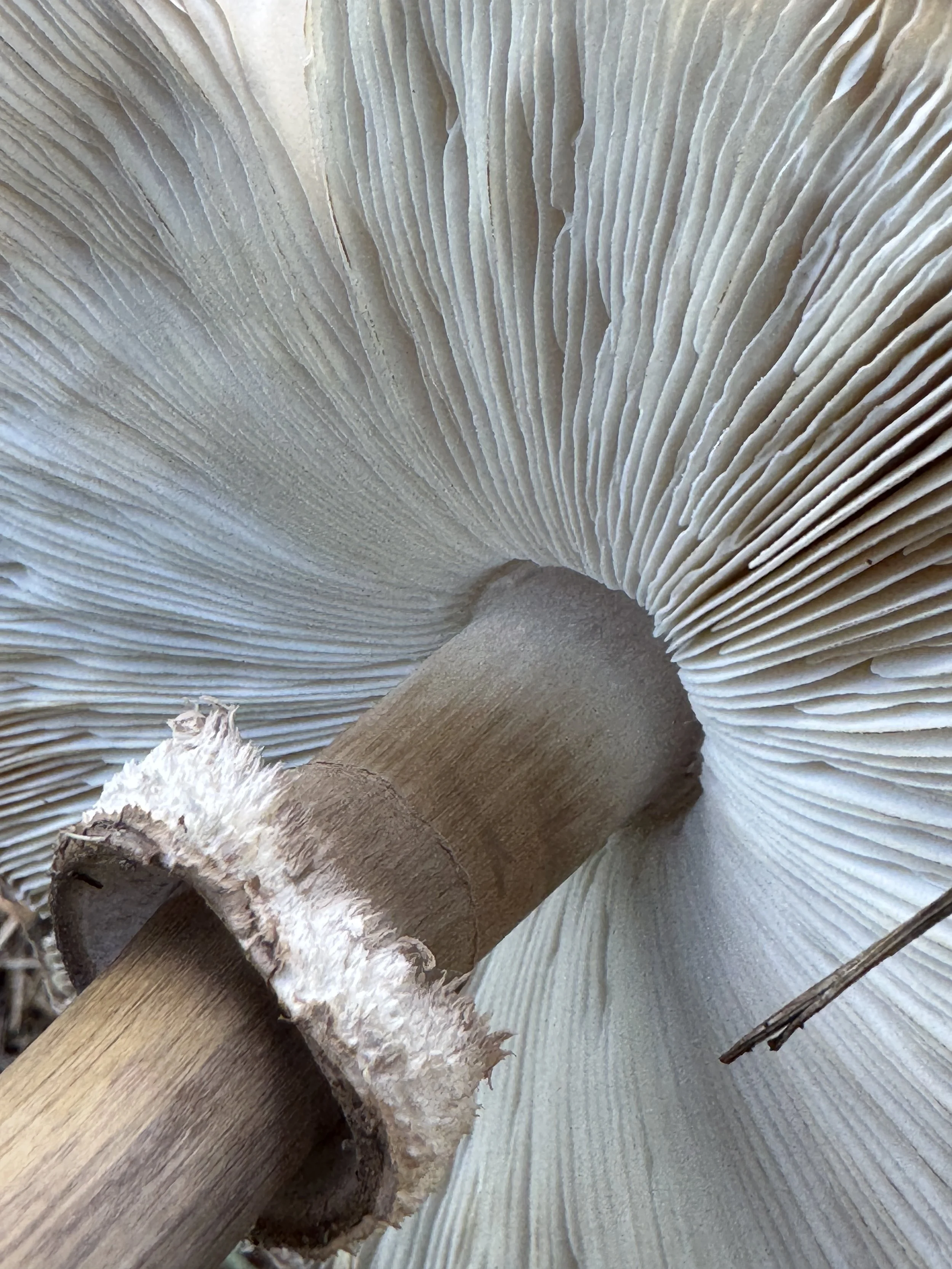
Shaggy parasol mushroom. Photos by Jenny Epstein Kessem.
It is addicting. I’ve been up in the forest, mushroom foraging six out of 14 days in the past two weeks, and today I’m searching my calendar for the next time I can get up there.
The woods are quiet and receptive. They invite me to be quiet and receptive, and do one thing at a time. For my attention, the woods feel like an antidote to what modern life demands—a pinging from one screen to the next with no pauses.
In certain rich moments I experience actual reciprocity in the woods—the woods are listening to me and I am responding back. When I tune in with my senses, the forest communicates what to do next. Listen to the sound of water and follow it, sense the slight temperature drop in a draw and follow it down, feel the soil soften under my step and go toward that softer zone, see the spongy roots and trace them, hold a mushroom and smell it to identify it, and literally follow my nose to the place the forest is showing me. This state is sensory joy, and it captures my rapt attention.
You can explore your own flavor of attention variance (i.e. ADHD) and your own sensory joys in our Relational Unmasking groups. Join us in-person or online in a safe space to learn about your own neurodiversity and find connection with others. It’s fun! Registration open now.
The forest manifesting a mushroom is magical. The mycelia listen and respond to environmental cues to grow an intelligent network. The mycelia await, latent and responsive beneath the surface for the complex set of conditions to produce a fruiting body, their way of reproducing. We animals help by finding and moving the mushrooms, spreading the spores which later create more mycelia. We are in an ancient reciprocal dance of interdependence.
We human animals have evolved to do this. As I forage, I feel my animal body doing something ancient: I am in relationship to the forest and I respond to it. When I find food, I feel a sharp brightening of my attention. It feels good. I pay attention: what are the conditions under which I found this food, and how can I pay attention to the pattern in order to repeat this awake feeling, to find more food?
When I was first learning about mushroom foraging, I was also working as a therapist with people with severe addictions. Each time I found a mushroom, I would get excited and want to find more. I would want to repeat the hit of dopamine I experienced. It was addicting. This realization helped me to understand the grip of addiction so many of my clients were experiencing with meth, with alcohol, or with screens. It was the same evolutionary process we were in. Dopamine brightens attention and induces repetition, whether one gets it from mushroom foraging or taking one more drag from the cigarette. Evolution gave us this chemical support to motivate finding food. It’s about what we pay attention to and it’s about our survival.
This built in system is wonderful, and it can also hook us. Even though mushroom foraging is not terribly dangerous*, I have gotten so hooked that I’ve lost hours of time, finding myself in the forest at dusk, very late to dinner. I have also gotten into an extractive state, desperately rushing to find as many mushrooms as possible. A dopamine-driven foraging mind-storm can be destructive. How to ride this attentional boost, while also respecting that I am an integral part of a system much larger than me? While foraging last weekend, I sang a made-up song to myself with the words, “I am listening. I am listening.” When I come upon an edible mushroom, I remind myself to say, “I am listening” before harvesting it. These practices can slow the fire of my colonial and extractive mind habit, so that I am paying attention, but also paying attention with the reciprocal parts of my nervous system.
The sensory depth of focus is a balm to my nervous system, otherwise scattered and overwhelmed by modern life. If I already know that I have a system that has trouble paying attention to certain things, or if I have an attention variance sometimes called ADHD, it is natural to find pathways to wake up and pay attention. It is also not coincidence that many people with said attention variance find themselves in habitual patterns or addictions. Reward and repetition release dopamine. Those dopamine hits are relieving, or daresay medicinal, for the scattered mind. Also medicinal for me is the gift of sensory joy that foraging brings. Modern life asks me to follow protocol, attend to the rules and process information in a top-down way. Foraging, on the other hand, is sensory and intuitive, a bottom-up process, and this yields sensory joy.
Many neuroexpansive people discover their own pathways to sensory joy that are medicinal—what are your pathways?
*Please forage wisely. Never eat a mushroom unless you know exactly what it is. AI mushroom identification is notorious for misidentification and therefore dangerous.
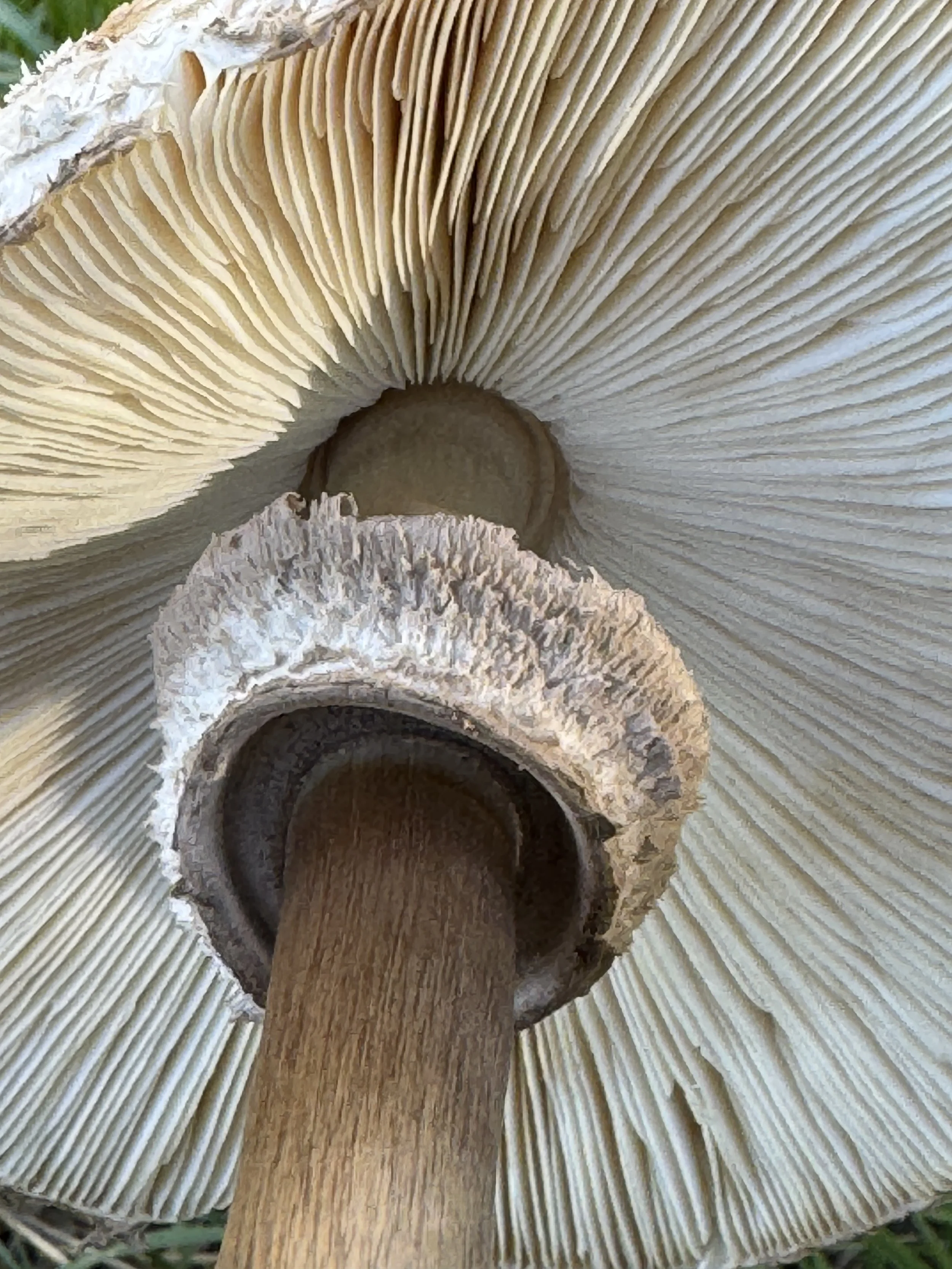
The underside of a shaggy parasol mushroom.
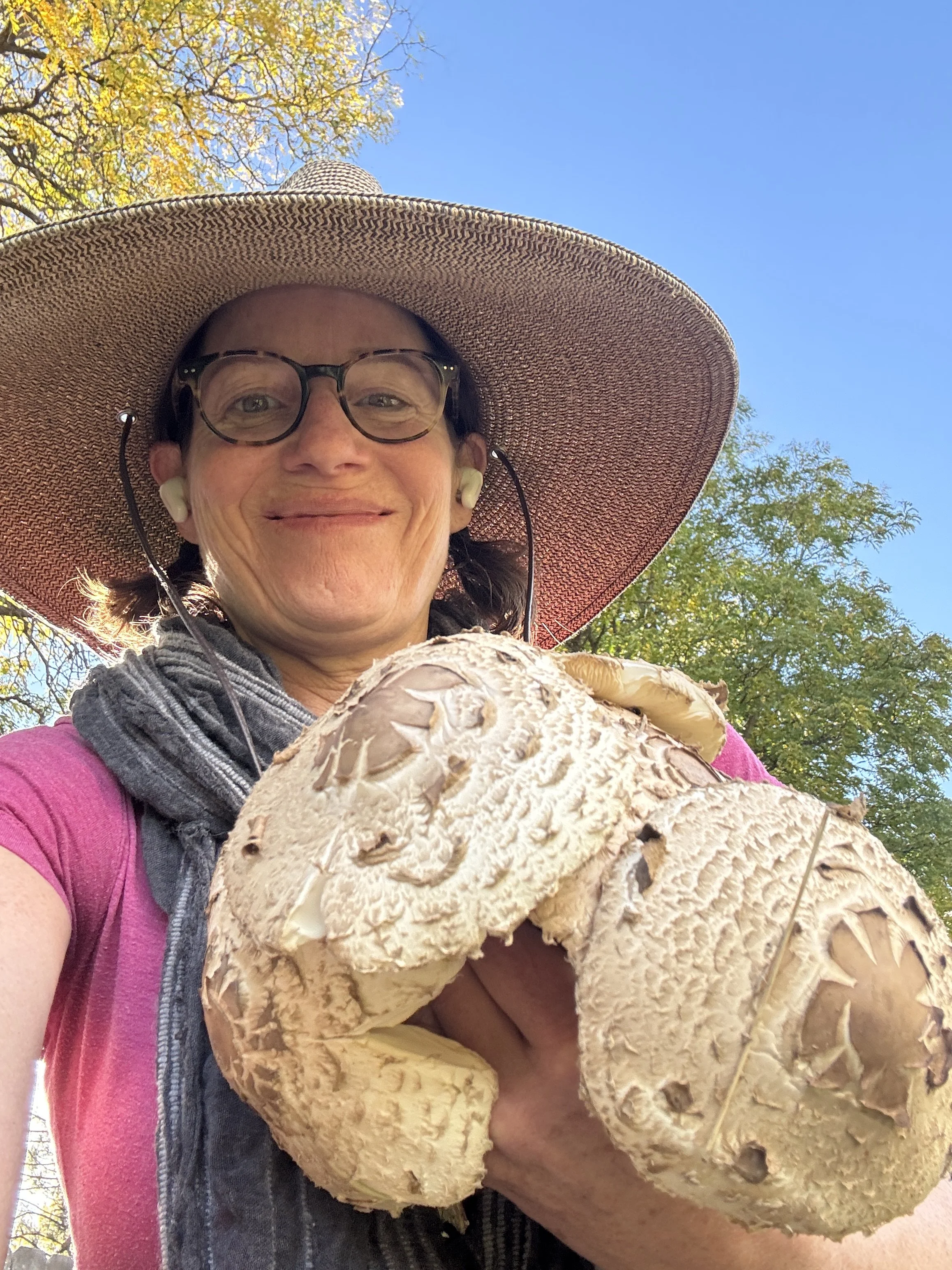
This is me last fall, after just discovering shaggy parasol mushrooms in a residential neighborhood.

