
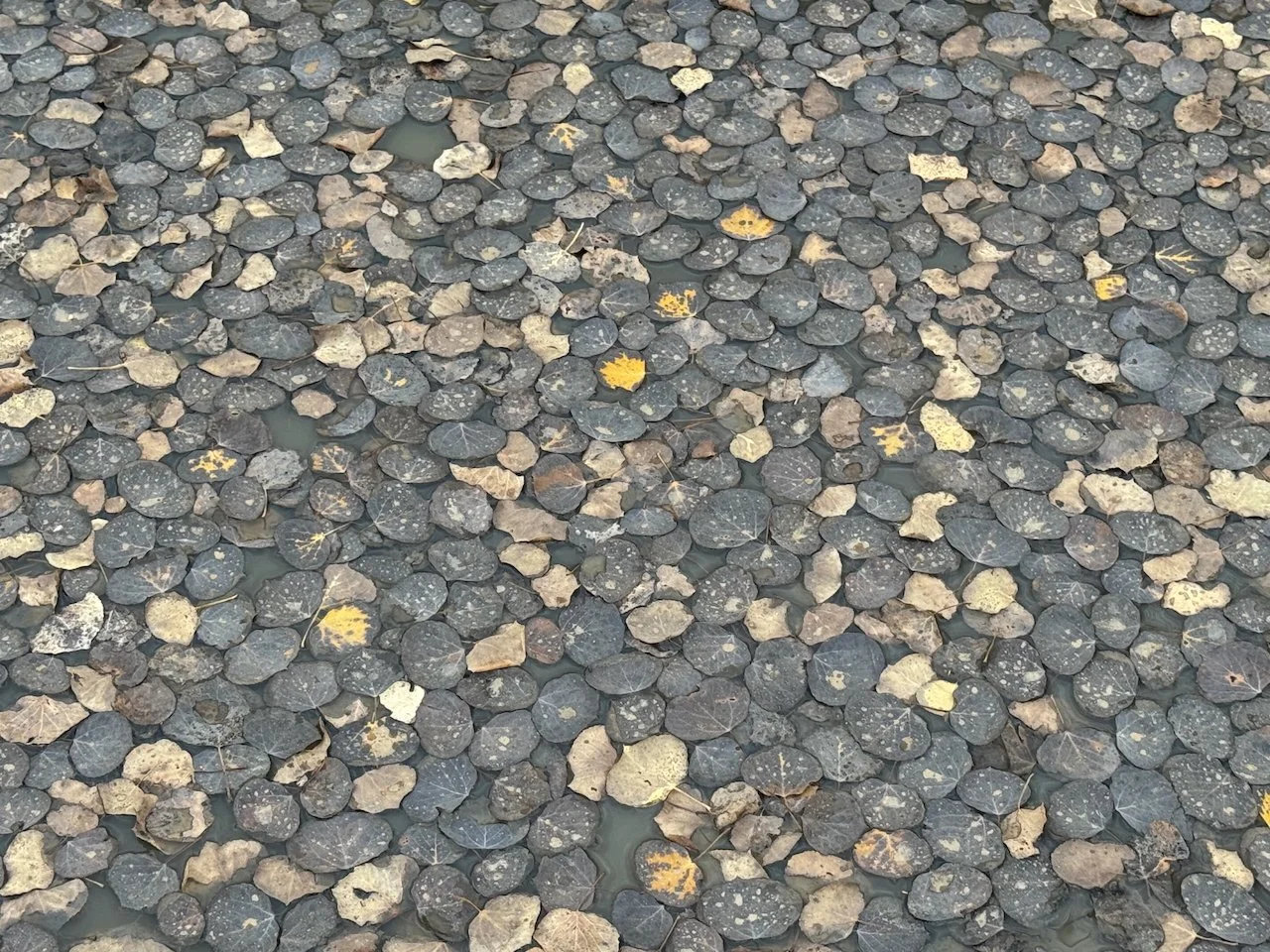
Aspen leaves in a roadside ditch in Como, Colorado. Photo by Jenny Epstein Kessem, October 2026.
For many neurodivergent people, our sensory worlds are intense. Embracing the richness of this intensity allows us to be wildly creative with our differently organized minds.
It’s no accident that many paradigm-breaking creators are thought to be neurodivergent—we process information differently than neurotypical folk: Think daVinci, Einstein, Frida Kahlo, Picasso, Van Gogh, Virginia Woolf, Georgia O’Keefe, Mozart, Escher, Andy Warhol, Stanley Kubrick, Steve Jobs, Billie Eilish, Greta Thunberg.
A compelling theory that explains this processing difference is the intense world theory, a neurobiological explanation of autism. The theory suggests autistic people have more neuronal branching than neurotypical people. This allows more opportunities for mind and body connection. Hyperconnectivity in the nervous system can result in giftedness and synesthesia. It can also lead to sensory overwhelm and other challenges. (Trauma Geek, 2026)
Therefore, in the Relational Unmasking program we center sensory needs because they are foundational to get to other unmasking needs. Accommodating sensory needs reveals other truths.
For me, a fairly good indicator that I am masking is tension in my body. Conversely, when my body is relaxed, I am likely to be less masked. The tension in my body “masks sensation” (Steve Paxton, 1977). With sensation less accessible to me, I don’t know what I am feeling, I don’t know what I need, and I cannot therefore advocate for myself without that missing data. I also may feel numb, flat, or depressive and have difficulty accessing positive emotions such as connection, joy and integration. The connective pathways are simply less available. And yet many of us learn to survive an overwhelming society designed for neurotypical bodies by numbing out.
Unmasking As a Whole Body Experience, A Community Event. Join us for sensory delights on Nov 13th, 6-9pm at Nyland Cohousing in Lafayette. Pre-register HERE.
In his book Neurodivergent Somatics in Therapy (2026), Nyck Walsh describes our neurodivergent capacity for sensory joy as profound. He adds that “accessing joy through sensory pleasure is a profound act of neurodivergent resistance.” He suggests that finding pleasure in our sensitive neurodivergent nervous systems “inherently dismantles and deconstructs the diseases of colonization: capitalism, white supremacy, cis-heteronormativity and neurotypicality”. Our sensory joy is a reorganization of what matters, which brings us closer to our authenticity.
Sensory joy can be an antidote to some of the struggles of the neurodivergent experience: sensory aversions, neurodivergent overwhelm, dysregulation and chronic stress, neurodivergent burn out, numbing, disconnection or dissociation. What if we support sensory exploration, sensory discovery, and sensory autonomy in community as a way to be more authentic?
Join us this November 13th, 6-9p at Nyland Community House to participate in this grand sensory experiment. It will be a choose-your-own sensory-adventure, with stations to immerse in various sensory experiences: music, sound and voice; movement; tactile experiences; visual art; and working with plants.

